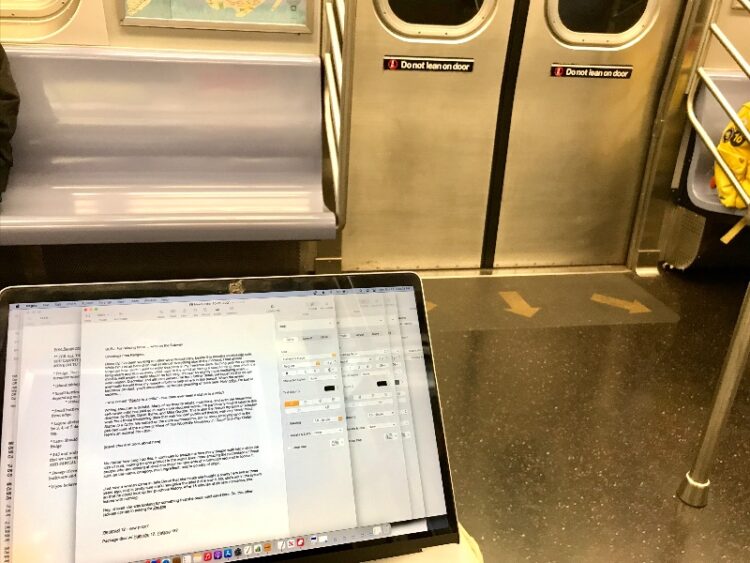
Greetings Free Rangers,
Recently, I’ve been working on other wine related copy, beside this (mostly) weekly(-ish) note. While I’m just as behind on that as almost everything else at the moment, I had almost forgotten how much I used to enjoy deadlines, back in my freelance days. Nothing gets the synapses firing sharp and true in the direction of every other topic in the world as having a specific unrelated thing upon which the mind is well aware it really should be focusing. Discretion and altruism prevent me from further detail, but hopefully this list will eventually benefit from my honest efforts to help others in an important wine pursuit. When the reveal becomes prudent, you’ll understand my bottled gnashing of teeth in the here and now. Holy cr@p, I’m bad at secrets…
Anyway, writing about art is bullshit. Many of my favorite artists, musicians, and even the occasional self-aware critic has said so in many more eloquent words. I’m particularly fond of takes in this direction by Dylan, David Byrne, and Mike Gordon. This is also the reason my book of selected work from those freelancing days that was *almost* published (twice), was very nearly titled: Statue to a Critic. We settled on the admittedly cumbersome, but far more satisfying (and to the petrified core of that work): None of This Would Be Necessary if I Could Only Play Guitar. Here’s an excerpt from that.
From: The Genuine Article (c. 2004)
<—————————————>
I had started this piece a couple of years ago, shortly after sitting in on Jesse Jarnow’s interview with Hunter S. Thompson, but nobody cared and nobody was going to pay me for the damned thing. “Writers like to get paid,” Bob Love had told me in an unmasked moment. And it seemed I was no different. But if I wanted to see this one in print, I’d have to settle for artistic integrity, editorial control, and a pinch of free advertising.
Set up and hunkered down now in a bright yellow and white striped cabana by the pool, over-prescribed and under the misters. I had my office set up on the patio table in the center of the cabana, next to the giant fruit basket with a television eye glaring down from the corner, spouting sports scores my assistant required for the daily sports book. A taught and tan yet surly blond brought the pomegranate margaritas- no salt. I sucked them back, sweating badly, and pouring over my research materials and piles of notes. Plenty of bananas, no blow.
How many ways were there really to tell a decent story in what was left of modern print? There’s the Tom Wolfe thing, which is to do painstaking journalistic research on every detail of a story and then write the characters and their truths using the vocabulary and structure of good fiction. There’s the Kerouac thing which is to simply steal the story, really; to tell the romanticized version of the verbatim truth with yourself as the protagonist, but change all the names. And then, there was the Thompson thing, which was to locate the story, sit next to it on the trip, shoot it up with speedballs to the main vein, hit on it’s sister, crash it’s car, do all the research, roll up and smoke all the research, and then tell a completely different, tangentially related, story that’s much truer than what was originally assigned, and fuck the editors if they couldn’t take a joke.
The problem is that everything in our modern anti-culture is based on this myth of the dyadic system. It’s wholly unnatural. There aren’t two sides to every story, but that’s how popular history has recorded it all. If the story’s any good there are 17,892 sides to it; with infinite possible digressions and tangents.
To make an active record of something you must interact with it. By interacting with it, during the observation process, you have already affected it in some way. By this same principle in which the observed is affected, the results and conclusion are also afflicted: imprinted by the conscious and subconscious beliefs and biases of the observer. The scientific method controls for these biases with the double blind study, ensuring that neither the subjects nor the observers in a controlled experiment are privy to the actual goals of the study. But such empirical efficiency does not translate well from the scientific to the literary.
“When you run into harder issues, it’s easy to look for an escape,” Noam Chomsky once wrote. “And there are a lot of different escapes. You can escape by writing meaningless articles on some unintelligible version of radical academic feminism, or by becoming a conspiracy buff, or by working on some very narrowly focused issue, which may be important, but so narrow that it’s never going to get anywhere or have any outreach. There are a lot of these temptations.”
<—————————————>
What were we talking about? Doesn’t matter.
What does is that the whiskey boom barrels on (pun intended- thank you). The latest hits include Elijah Craig Barrel Proof significantly reducing allocations, Hibiki Harmory (the one Suntory released because they couldn’t keep up with demand for Hibiki 12) is now a highly allocated item, and as of the first of this month, Yamazaki 12 is now a 1 bottle NET wholesale item (no case break, nor full cases available), and the new wholesale cost for Yamazaki 12 is just shy of $115. Which means that the below deal is very likely the last time you will ever see Yamazaki 12 for $119, but that’s available via the link below with the purchase of any other bottle of whiskey.
Yamazaki 12 @ $119 w/ the purchase of any other bottle of whiskey !
(!) Click here to add Yamazaki 12 and SELECT YOUR OTHER BOTTLE (!)
*** One per customer! ***
*** This week only, as supplies last! ***
*** No other discounts apply! ***
Happy Hunting,
Jack
Proprietor
Free Range Wine & Spirits
P.S. Free Range E-mail Archive